
 By admin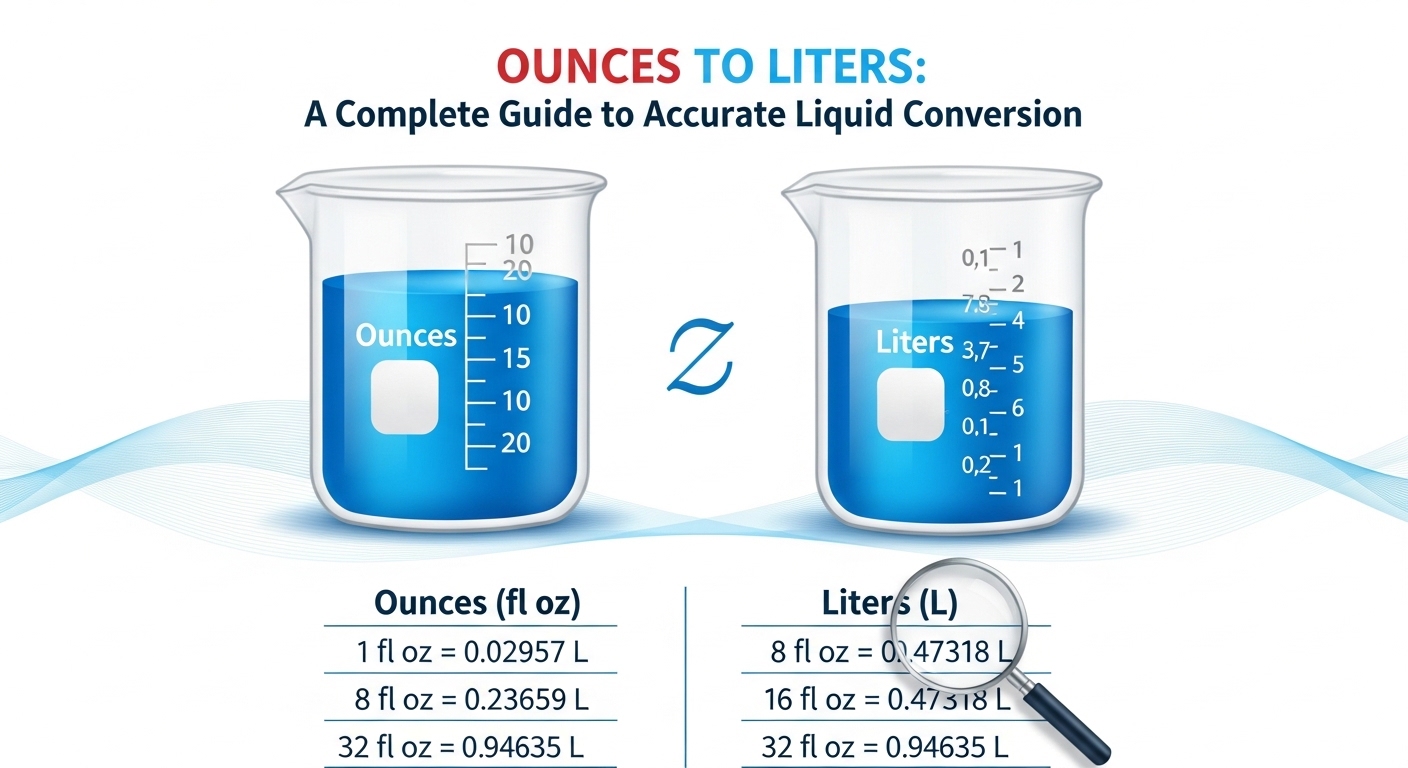
Converting ounces to liters is a common task in cooking, science, and everyday life, yet it can be confusing for those unfamiliar with measurement systems. Understanding how to accurately switch between these units ensures precision in recipes, experiments, and fluid calculations. Ounces are a part of the imperial system, commonly used in the United States, while liters belong to the metric system, widely adopted internationally. Mastering ounces to liters conversions not only simplifies measurements but also enhances efficiency and accuracy across various applications, making it an essential skill for both professionals and casual users.
Understanding Ounces
An ounce is a unit of volume or weight depending on the context, commonly used in the United States. In liquid measurements, a fluid ounce represents a specific volume, approximately 29.5735 milliliters. The ounce is practical for small-scale measurements in cooking, beverages, and laboratory experiments. However, because it belongs to the imperial system, it differs from metric units like liters. Understanding what an ounce represents is the first step in accurate conversion. Recognizing whether it refers to weight or volume ensures clarity, especially when translating recipes, scientific measurements, or fluid quantities for international use.
Understanding Liters
The liter is a metric unit of volume commonly used worldwide for measuring liquids. One liter equals 1,000 milliliters, providing a simple decimal-based system for calculations. Liters are widely used in scientific research, cooking, and commercial packaging due to their ease of use and global standardization. Unlike ounces, liters provide a straightforward metric measurement that is easy to scale up or down. Understanding the liter and its relationship to smaller units like milliliters allows users to convert ounces to liters accurately, ensuring precision in recipes, experiments, and fluid handling across different systems of measurement.
The Conversion Formula
To convert ounces to liters, you multiply the number of ounces by 0.0295735. This factor converts the imperial unit into the metric system. For example, 16 ounces multiplied by 0.0295735 equals approximately 0.473 liters. Using this formula ensures precise conversions for cooking, scientific measurements, and industrial applications. Understanding the math behind ounces to liters conversions allows users to calculate any volume accurately without relying solely on online converters. Familiarity with this formula also builds confidence when working with mixed measurement systems, making it a useful skill for professionals and hobbyists alike.
Practical Applications in Cooking
Converting ounces to liters is especially important in the kitchen, where precision affects the outcome of recipes. Many international recipes list ingredients in ounces, while local measuring tools may use liters or milliliters. Accurate conversion ensures correct proportions of liquids such as milk, water, and oils, preventing mistakes that could alter texture, flavor, or consistency. For example, converting 32 ounces of water to liters ensures the correct volume is used in baking or cooking. By mastering ounces to liters conversions, home cooks and professional chefs can follow diverse recipes accurately and consistently achieve desired results.
Applications in Science and Laboratories
In scientific and laboratory settings, accurate liquid measurement is crucial for experiments and chemical handling. Converting ounces to liters ensures that precise volumes are used, reducing the risk of errors or inconsistent results. Laboratories often operate with metric units, making conversion from ounces essential for international research or standardized procedures. Whether measuring solvents, reagents, or samples, understanding ounces to liters conversions allows scientists to maintain accuracy and safety. By applying the conversion formula and double-checking calculations, researchers can ensure reliable results, proper scaling, and compliance with scientific protocols.
Applications in Industry and Commerce
Ounces to liters conversions are also relevant in commercial industries such as beverage production, pharmaceuticals, and logistics. Many products are labeled in ounces for markets like the United States, but international shipping often requires liters. Accurately converting liquid volumes ensures proper packaging, labeling, and compliance with regulatory standards. For example, a beverage company shipping 128 ounces of juice internationally must convert this quantity to liters to meet metric labeling requirements. Mastery of ounces to liters conversions reduces errors in production and distribution, helping businesses maintain consistency and efficiency across global markets.
Common Mistakes and Tips
When converting ounces to liters, common mistakes include confusing fluid ounces with weight ounces or rounding incorrectly. Users should always ensure they are converting liquid volume, not mass, and apply the correct conversion factor. Using precise calculators or double-checking the multiplication can prevent errors. Additionally, understanding that slight variations may exist between U.S. and imperial fluid ounces helps maintain accuracy for international applications. Keeping a conversion chart or memorizing key factors, such as 32 ounces equal approximately 0.946 liters, simplifies frequent calculations and reduces mistakes in both professional and personal use.
Tools for Conversion
Several tools can simplify ounces to liters conversions. Online calculators, mobile apps, and conversion charts allow users to quickly determine equivalent volumes without manual calculation. Measuring cups marked in both ounces and liters can also assist in kitchens or laboratories. Digital scales with fluid conversion features provide an additional layer of precision. While these tools are convenient, understanding the underlying conversion factor remains important for verification and situations where digital tools are unavailable. Combining knowledge with practical tools ensures accurate, efficient, and reliable ounces to liters conversions across a wide range of applications.
Tips for Accurate Measurement
To ensure precise measurement when converting ounces to liters, use appropriate tools such as graduated cylinders, measuring cups, or calibrated containers. Double-check calculations, especially for large volumes, and account for minor rounding differences. Being consistent in using either U.S. or imperial units prevents confusion. Keeping a quick reference chart for commonly used volumes streamlines tasks and reduces errors. By applying careful measurement practices and understanding the ounces to liters conversion, users can maintain accuracy in cooking, scientific experiments, and commercial applications, ensuring reliable results every time.
Conclusion
Converting ounces to liters is an essential skill for anyone working with liquids in cooking, science, or industry. Understanding the formula, applications, and common pitfalls ensures precision and efficiency across different measurement systems. With practical tools, careful calculation, and consistent practices, users can confidently convert ounces to liters, bridging the gap between imperial and metric units. Mastery of this conversion enhances accuracy, supports international standards, and ensures successful outcomes in both professional and everyday applications.