 By admin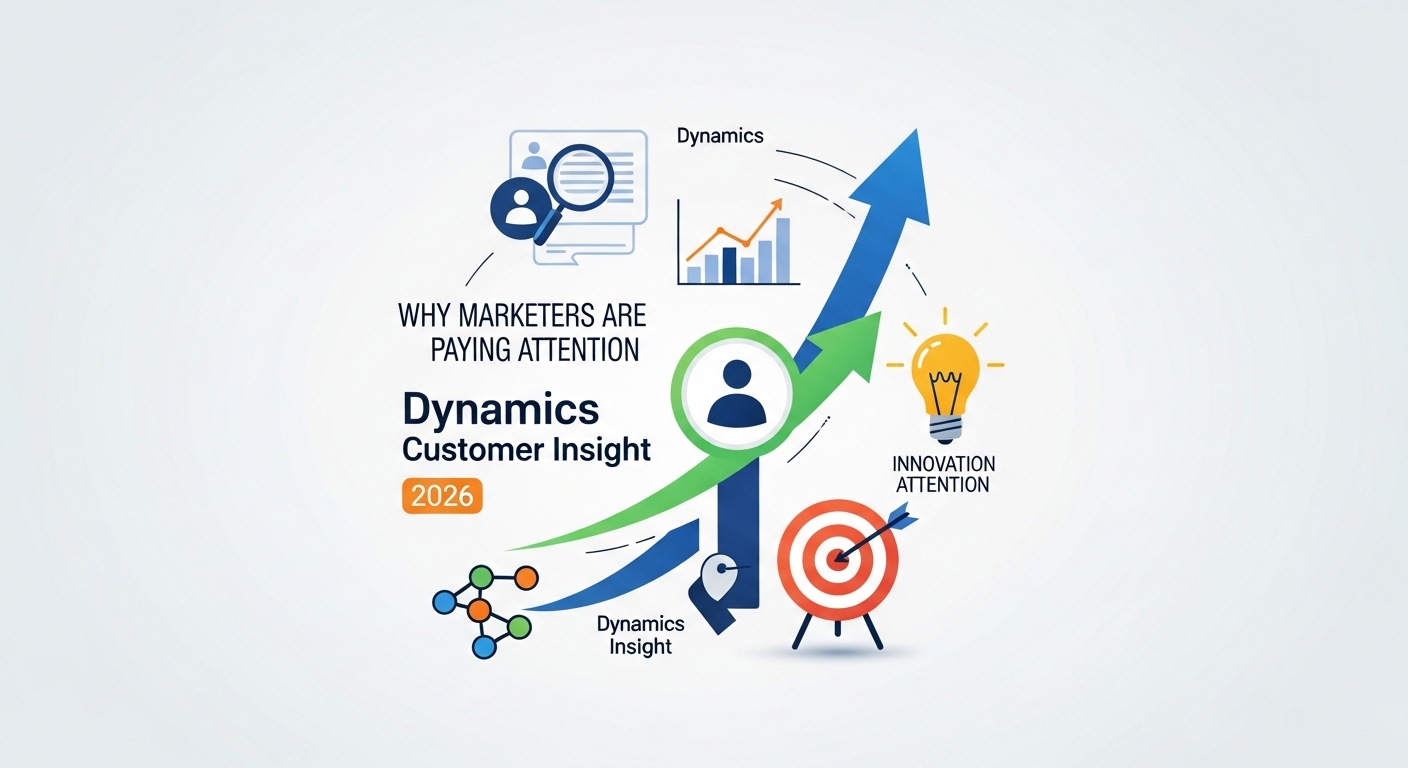
Marketing teams are under more pressure than ever to prove impact. Pipeline contribution, conversion quality, channel efficiency, customer retention, and personalization are all being measured more closely. That is pushing marketers to rethink the systems behind their campaigns, customer data, and journey orchestration.
In 2026, that shift is becoming more visible. Marketers are no longer satisfied with disconnected tools that store data in one place, automate campaigns in another, and report results somewhere else. They want a setup that helps them understand customers better and act on that understanding faster. Microsoft’s current Customer Insights approach combines Customer Insights – Data and Customer Insights – Journeys to support that model.
That is one reason more teams are paying attention to Dynamics Customer Insight. The interest is not only about having another marketing tool. It is about using unified profiles, real-time journeys, and a stronger connection across sales, service, and marketing to make customer engagement more relevant and measurable.
Marketing is moving from campaign execution to customer orchestration
A few years ago, many teams could still get by with separate tools for email, segmentation, forms, and reporting. That model now creates too much friction. Customer expectations move faster, buying journeys are less linear, and teams need better timing across touchpoints.
Marketers need context, not just contact lists
Modern campaigns perform better when marketers know more than a name and email address. They need a broader customer view: behavior, preferences, recent interactions, service history, segment membership, and journey stage. Dynamics 365 Customer Insights – Data is built to unify customer data from multiple sources, enrich profiles, and support predictions, segments, and measures that can be activated across channels.
That matters because better context changes how marketing works. Instead of sending the same message to a broad audience, teams can design journeys around real customer behavior and current business signals.
Real-time journeys are changing what marketers expect
One of the biggest reasons marketers are paying closer attention in 2026 is the shift toward real-time engagement. Microsoft has continued investing in real-time journeys, and new customers use that as the default model. Microsoft also states that outbound marketing was removed after June 30, 2025, making the transition to real-time journeys a practical necessity for remaining users.
This changes campaign thinking
Real-time journeys let organizations trigger engagement based on customer actions, choose channels such as email, SMS, or push, and react in moments that matter rather than waiting for scheduled batch execution.
For marketers, that creates several advantages:
● Faster response to intent
Campaigns can react when a customer takes action, instead of waiting for the next scheduled send.
● Better timing
Messages can be delivered closer to the point of need or interest.
● More relevant journeys
Behavior-based engagement usually performs better than static audience flows.
● Stronger end-to-end coordination
Marketing can work more closely with sales and service activities rather than working in isolation.
Customer data is becoming a competitive advantage again
Personalization is not new, but the bar is higher now. Sending a first name in an email no longer counts as sophisticated marketing. Teams need cleaner data, better segmentation, and a clearer picture of how customers move across channels.
Unified profiles support smarter decisions
Customer Insights – Microsoft positions Customer Insights as a customer data platform that helps create a holistic, up-to-date customer view by bringing together multiple data sources. That gives marketers a stronger base for segmentation, activation, and analysis.
The real value here is practical:
- audiences become easier to define
- campaign targeting improves
- teams reduce duplicate or conflicting outreach
- marketing and sales work from a more consistent customer view
- reporting becomes more meaningful because it is built on better-connected data
This is also why attention is coming from beyond classic B2C teams. Even businesses managing broader tech stacks, including platforms like Simplicant, are starting to think more seriously about how customer and prospect data should be connected across the organization rather than remain trapped in separate systems.
Microsoft’s 2026 roadmap is reinforcing the interest
Another reason marketers are paying attention is momentum. Microsoft’s 2026 release wave 1 plan for Customer Insights – Data and Customer Insights – Journeys shows continued product investment from April 2026 through September 2026. Microsoft also maintains a rolling “what’s new” stream for Journeys, with updates published during 2026.
Product momentum matters to marketing leaders
Marketers do not just choose tools based on the features they need today. They also look at where a platform is heading. Ongoing investment matters because it affects:
● Future campaign capability
Teams want confidence that the platform will continue to improve.
● Long-term planning
A tool with active roadmap momentum is easier to build around.
● Adoption confidence
Internal stakeholders are more likely to support platforms that continue evolving.
This is especially relevant for organizations already invested in the Microsoft ecosystem. A marketing platform tends to become more attractive when it can sit closer to the broader business stack.
Why this matters for business results, not just martech
The strongest reason marketers are paying attention is simple: better systems support better outcomes. When data is fragmented and campaign logic is outdated, teams spend too much time fixing process issues and not enough time improving performance.
Better orchestration can improve the basics
For many teams, the practical gains are more important than the product language. They want to:
● build cleaner segments
Without relying on manual exports
● respond faster
To customer actions and intent signals
● improve relevance
Across email, forms, events, and triggered communication
● align with sales and service
Instead of treating marketing as a separate function
● measure outcomes more clearly
Across journeys and channels
When a platform supports those goals, marketers pay attention. That is exactly why Customer Insights is becoming a more serious conversation in 2026.
What marketers should evaluate before adopting it
Interest does not mean automatic fit. Teams should still assess whether the platform matches their business model, internal maturity, and data readiness.
Key questions to ask
1. Is our customer data usable enough?
A journey platform performs best when the underlying data is clean and governed well.
2. Do we need real-time engagement?
If timing and behavior-based responses matter, the case becomes stronger.
3. Are our teams too fragmented today?
If marketing, sales, and service all work with different views of the customer, the connection becomes more valuable.
4. Do we want one platform to do more?
Some organizations are actively reducing tool sprawl and looking for tighter alignment across systems.
These questions are often more useful than comparing feature lists alone.
Final thoughts
Marketers are paying attention to Dynamics Customer Insights in 2026 because the market is asking more from marketing teams. Better personalization, faster response times, greater customer visibility, and closer cross-functional coordination are no longer optional for many organizations.
Microsoft’s continued investment in Customer Insights – Data and Customer Insights – Journeys, combined with its push toward real-time engagement, is making the platform more relevant for teams that want to move beyond disconnected campaign execution.
For marketers, the real question is not whether another tool can send campaigns. It is whether the platform helps the business understand customers better and act on that understanding at the right time. That is why this conversation is getting harder to ignore in 2026.