
 By admin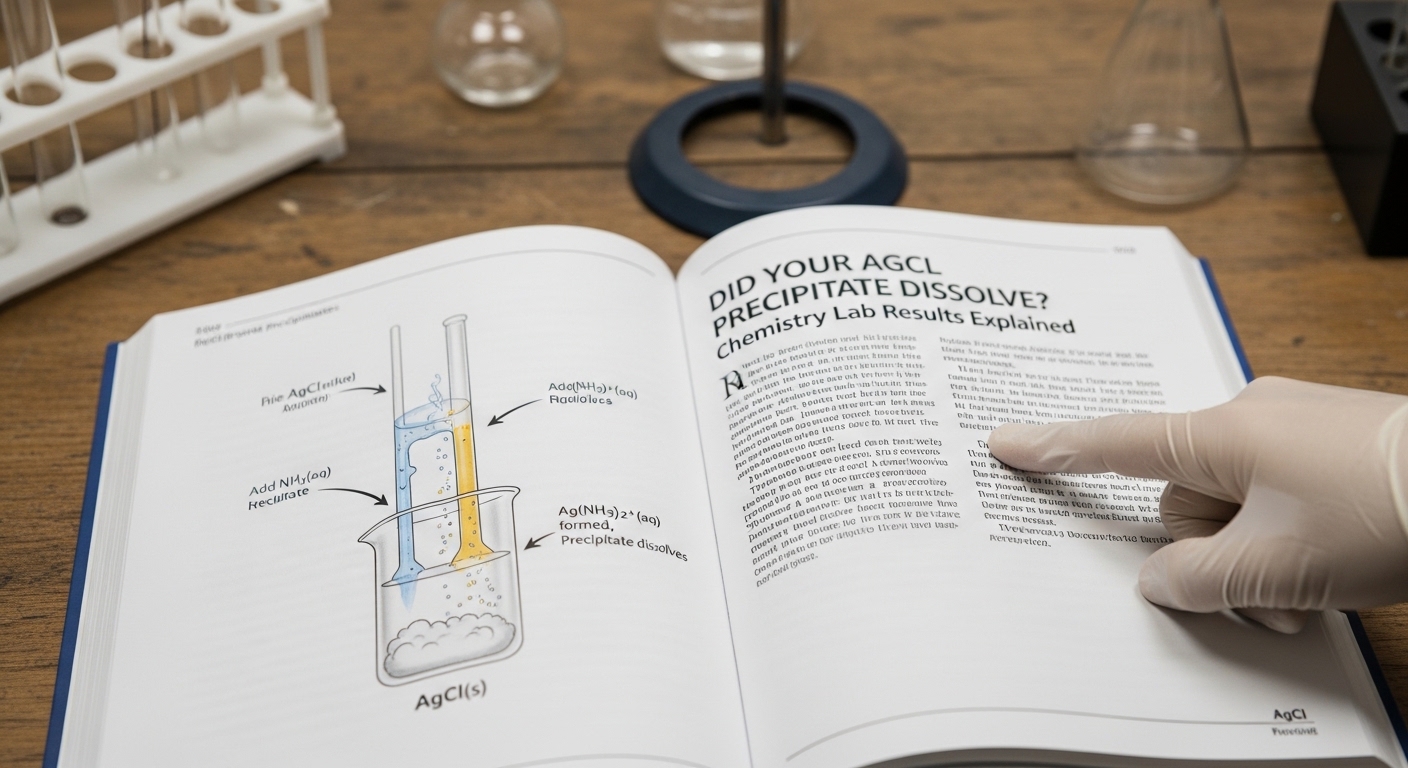
In chemistry experiments, students and researchers often encounter silver chloride as a classic example of a precipitate. When asked the question, did the precipitated AgCl dissolve explain, it invites a deeper look at the properties of silver chloride and the factors affecting its solubility. Understanding why AgCl either remains solid or dissolves under certain conditions helps clarify key concepts in chemical equilibrium, solubility rules, and reaction dynamics. Exploring these principles provides insight into both theoretical and practical aspects of chemistry, making it an essential topic for laboratory studies and educational exercises.
Formation of Precipitated AgCl
Precipitated AgCl forms when solutions containing silver ions and chloride ions are mixed. According to the reaction Ag⁺ + Cl⁻ → AgCl(s), a solid precipitate is produced due to the low solubility of silver chloride in water. This process is a clear example of a double displacement reaction, where the insoluble product separates from the aqueous solution. The formation of AgCl can be observed visually as a white, cloudy solid. Understanding how this precipitate forms is critical before addressing its solubility, as the initial conditions determine whether the solid remains stable or can interact with other chemicals to dissolve.
Solubility Properties of Silver Chloride
Silver chloride is considered an insoluble salt in water under normal conditions. Its solubility product constant (Ksp) is very low, indicating that only a tiny amount of AgCl can dissolve in pure water. The solubility of AgCl depends on the concentration of ions in the solution and the temperature. Since Ksp represents the maximum concentration of ions in equilibrium with the solid, the precipitated AgCl typically remains undissolved unless chemical conditions change. These properties are essential to understand when answering the question, did the precipitated AgCl dissolve explain, because they show why the solid is stable in typical laboratory settings.
Effect of Complexing Agents
The solubility of AgCl increases in the presence of complexing agents such as ammonia. When ammonium hydroxide is added, silver ions form a soluble complex, [Ag(NH₃)₂]⁺, which shifts the equilibrium and causes the precipitate to dissolve. This principle demonstrates Le Chatelier’s principle, where the removal of Ag⁺ ions from the solid phase favors dissolution. This scenario explains why, under certain chemical conditions, the precipitated AgCl does dissolve. Recognizing the role of complexing agents helps chemists control reactions and selectively dissolve otherwise insoluble salts for analytical or experimental purposes.
Effect of Ionic Strength
The ionic strength of the solution can influence the solubility of AgCl. High concentrations of other ions in the solution can reduce or enhance the precipitation process depending on interactions between ions. In general, the common ion effect reduces the solubility of AgCl, as additional chloride or silver ions suppress dissolution. Conversely, solutions that remove one of the ions from equilibrium can enhance solubility. This dynamic is critical for explaining why precipitated AgCl may remain intact in some solutions while dissolving in others. Understanding ionic interactions provides a comprehensive answer to the question, did the precipitated AgCl dissolve explain.
Temperature Influence on Dissolution
Temperature changes also affect the solubility of silver chloride. While AgCl has low solubility at room temperature, increasing the temperature slightly enhances its ability to dissolve in water. However, because AgCl is extremely insoluble, temperature effects are relatively minor compared to chemical interventions like complex formation. Laboratory experiments often maintain room temperature to observe standard precipitation, emphasizing chemical rather than thermal factors. Recognizing the role of temperature helps chemists differentiate between physical and chemical influences on the dissolution of precipitated silver chloride.
Le Chatelier’s Principle and AgCl
Le Chatelier’s principle provides a framework to predict whether precipitated AgCl will dissolve under changing conditions. If a reaction component is removed or a chemical equilibrium is shifted, the system adjusts to restore balance. For AgCl, removing Ag⁺ ions through complex formation or increasing Cl⁻ concentration in a controlled manner can shift equilibrium and induce partial dissolution. Applying this principle allows chemists to manipulate the solubility of otherwise insoluble salts. It is a key concept when answering, did the precipitated AgCl dissolve explain, because it demonstrates that dissolution is context dependent rather than spontaneous under all conditions.
Practical Applications of AgCl Dissolution
The ability to dissolve AgCl selectively has practical applications in analytical chemistry. In qualitative analysis, the controlled dissolution of silver chloride allows for separation, titration, and identification of specific ions. In industrial processes, silver recovery and purification may involve converting solid AgCl into soluble complexes. Understanding the conditions under which precipitated AgCl dissolves enhances laboratory accuracy and safety. Explaining the solubility behavior of AgCl provides chemists with tools to design experiments, manipulate equilibria, and achieve predictable results in both educational and professional settings.
Common Misconceptions
A frequent misconception is that all precipitates are completely insoluble in water. In reality, the solubility of AgCl, although extremely low, is not zero. Under specific conditions, such as the presence of ammonia or other ligands, it can dissolve entirely. Misunderstanding these principles may lead students to incorrect conclusions during experiments. Recognizing that the dissolution of AgCl is conditional clarifies the answer to, did the precipitated AgCl dissolve explain. Chemistry relies on understanding not just whether reactions occur, but under which circumstances they proceed and how environmental factors influence outcomes.
Laboratory Observations and Techniques
Observing whether AgCl dissolves in a laboratory setting requires careful manipulation of solution conditions. Adding complexing agents, controlling ionic strength, and measuring temperature effects allows students to see the effects predicted by theory. Laboratory techniques such as filtration, centrifugation, and titration help quantify how much AgCl dissolves under varying circumstances. These observations reinforce theoretical concepts and provide concrete evidence for solubility behavior. By combining experimentation with chemical principles, students gain a complete understanding of why precipitated AgCl may or may not dissolve.
Conclusion
The question, did the precipitated AgCl dissolve explain, involves understanding the chemical properties, solubility rules, and equilibrium dynamics of silver chloride. While AgCl is largely insoluble in pure water, its dissolution can occur under specific conditions, including the presence of complexing agents or changes in ionic concentration. Factors such as temperature, ionic strength, and chemical equilibria play a crucial role in determining whether the precipitate dissolves. By studying these influences, chemists can predict, manipulate, and observe the behavior of AgCl in laboratory and industrial settings, providing a clear explanation for its solubility behavior.